
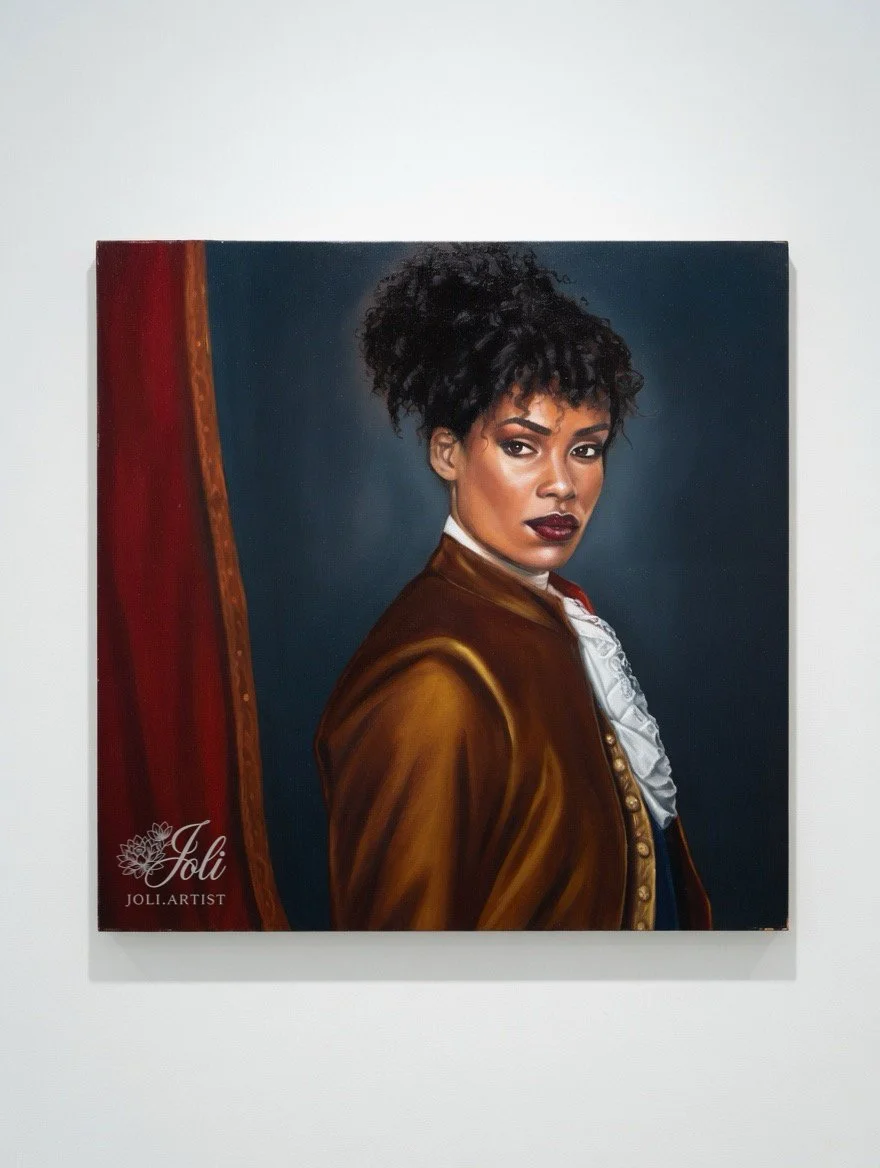
The woman before the office.
Beyond the red curtain, the day continues. Someone is waiting for a decision. An argument has reached the point at which everyone has said what they came to say. Soon, she will return to it.
For this moment, she gives us her attention.
Look at the angle of her head. There is a slight lift to it, a composure that gathers the whole portrait around her face. Her eyes hold the encounter. We may have arrived with questions about her title, her country, the world she governs. Standing before her, those questions become more personal: what has she understood about us? How much has she already decided?
This is The Prime Minister, an original oil painting from Joli’s Power collection. Her office gives the portrait its name. Her presence gives it its life.
A portrait perceived across timelines.
When I speak about this painting, I reach for “imagined,” then find myself correcting it. I see her. Perhaps I tapped into something; perhaps I perceived a reality in which this woman exists and holds power. The painting is the part of that encounter I can bring into view.
It is difficult to put into words what her face communicates. Her eyes and the way she holds her head carry so much of it. I can paint that recognition more readily than I can explain it.
“You can just look at her face. You can kind of see who she is when she stands before you.”
Her pose emerged with that same sense of recognition. This was how she wanted to stand before us; this was how she wanted to be painted.
Benjamin Disraeli and the language of power.
Benjamin Disraeli was a model for her. The reference gave me a way into the bearing of a political portrait: its formality, its posture, the gravity surrounding a person entrusted with power.
In the painting, a brown-gold coat catches the light. A white cravat draws the eye towards her face. The red curtain and dark blue ground give her presence a setting, while her expression keeps our attention. These are the materials of a recognisable portrait tradition, brought into contact with another reality.
Our own history already contains queens, in Africa as well as Europe. Women holding power have a history. Here, that recognition opens onto a wider world, a reality whose underlying order has always been matriarchal.
Meeting her on her own terms.
The women in these paintings belong to that world. Their bearing, their roles and the way they meet our eyes come from it. They are not posed for the male gaze.
The Prime Minister’s life extends beyond the frame: into the room behind the curtain, into the decisions awaiting her, into a history we are only beginning to encounter. The portrait offers an introduction. Her gaze leaves the rest open.
This is where the painting brings us: close enough to recognise a person, with a whole world still beyond our reach.
Artist’s reflection adapted from Joli’s account of the painting. The opening scene is part of the alternate-timeline narrative.
The Emperor · The Diplomats · The Statesman & Her Guard
View the original painting
The Prime Minister is an original oil painting on canvas, measuring 40 × 40 inches. View photographs, price and current availability of The Prime Minister.